ABS stops the wheels locking when you brake hard or on a slippery road, so the car does not slide sideways and you can still steer.
How to brake in an emergency
- 1Press the brake pedal firmly and keep it pressed.
- 2Steer around the obstacle if there is room - you can still steer while ABS works.
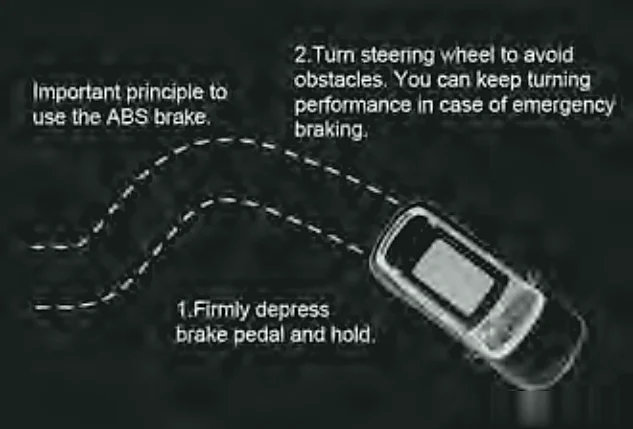
ABS only works under sudden, hard braking. You will feel the pedal pulse and hear noise - this is normal. Never release the pedal.
Normal ABS noises
- The brake pedal kicking back.
- Knocks between the suspension and body under emergency braking.
- The motor, valves and pump in the hydraulic unit working, including when EBD acts.
- A brief buzz after switching on or starting, while the system self-tests.
Keep extra distance
On rough or potholed roads, with snow chains, and on dirt, gravel or snow.

ABS fault
Warning:If the ABS indicator and the brake system indicator are on together, stop somewhere safe, away from traffic, and contact an authorised Jaecoo service centre immediately.
Warning:ABS does not remove the risks of following too closely, driving through water, turning quickly or poor road surfaces. Braking distances can still be long - with snow chains, or on sand or snow, they can be longer than without ABS.
Warning:In the wet, keep your speed down - if a wheel spins or slides, ABS cannot control the car. Steering and stability still have limits while ABS works.
Caution:Tyre size and tread wear greatly affect ABS. Replacement tyres must match the original size, load rating and construction - ideally the original brand, fitted by an authorised Jaecoo service centre.
Caution:Slow down for bends. If ABS has a fault, have it checked by an authorised Jaecoo service centre as soon as possible.